



Introduction
The Australian Space Technology Research Organisation (ASTRO) is sponsoring Australia's first manned expedition to Mars. The mission plan calls for the spacecraft to set down in the Elysia Planitia lowlands, at a landing site pre-levelled by a previous autonomous rover mission.
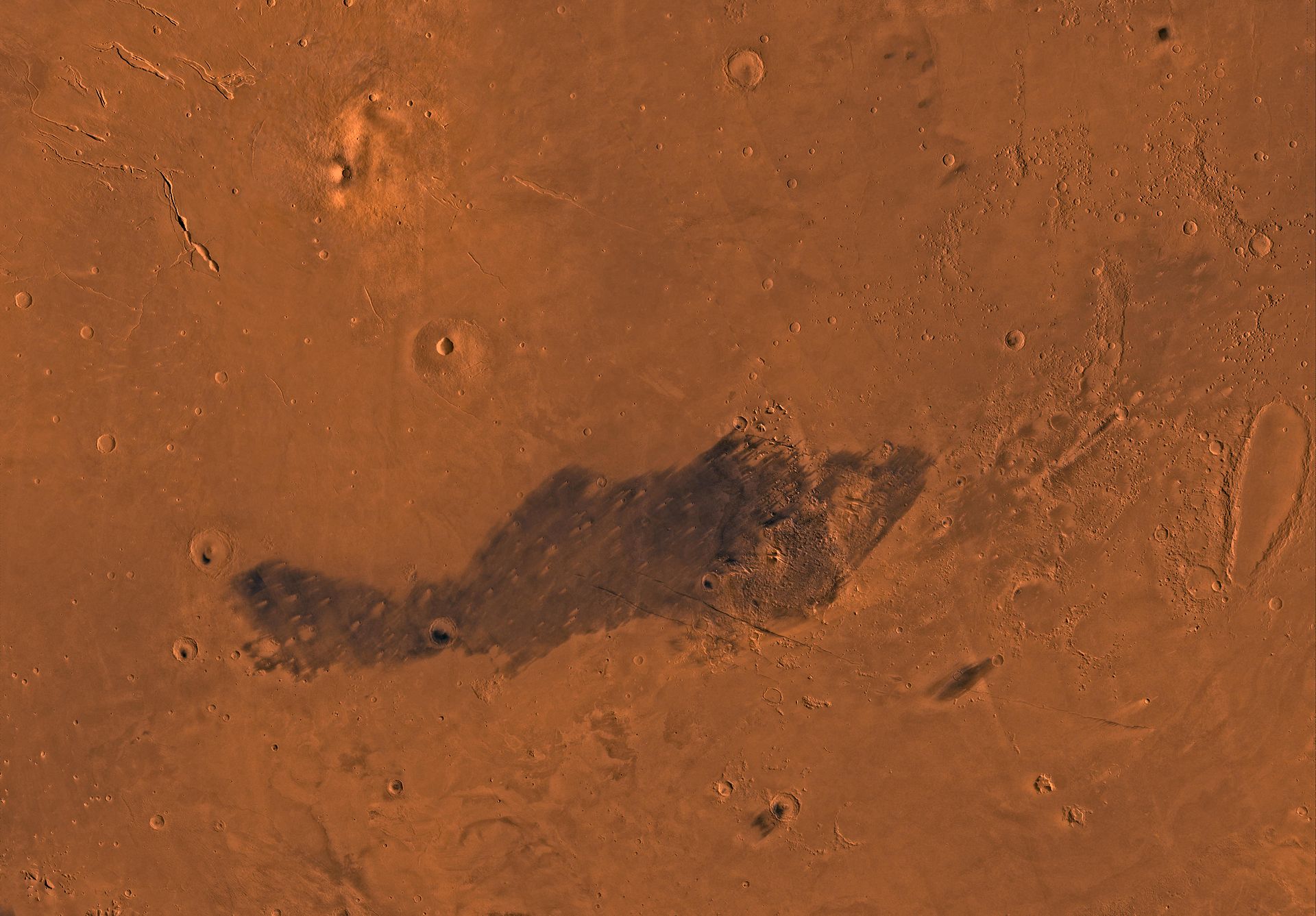
Your team has been selected to participate in this historic endeavour as part of the atmospheric entry engineering team. Though carrying the expedition crew, the craft's descent will be entirely autonomous, with no human intervention except to activate an abort mode. The spacecraft's high weight prohibits relying solely on parachutes or cushions as deceleration systems; one or more thrusters must be used, with or without other systems.
Your task is to build a powered descent-arrest system for the spacecraft's terminal landing phase: the spacecraft is to release from its service module, then descend through the atmosphere under gravity, decelerate and touch down at the mission site. Given the presence of a human crew, the landing must be as gentle as possible, and ideally as close to the centre of the designated landing zone.
The spacecraft will transmit atmospheric, orientation, and acceleration data to allow Mission Control back on Earth to monitor its progress during descent. The spacecraft must also carry a condition sensor to measure and indicate the forces to which the astronauts are subjected during landing, and thus allow the health status of the crew to be determined. Mission Control will receive the telemetry from the spacecraft, extract and plot the measurements live, followed anxiously by billions!
The world is watching - failure is not an option!